

FIND THE CONTENTS THAT INTEREST YOU
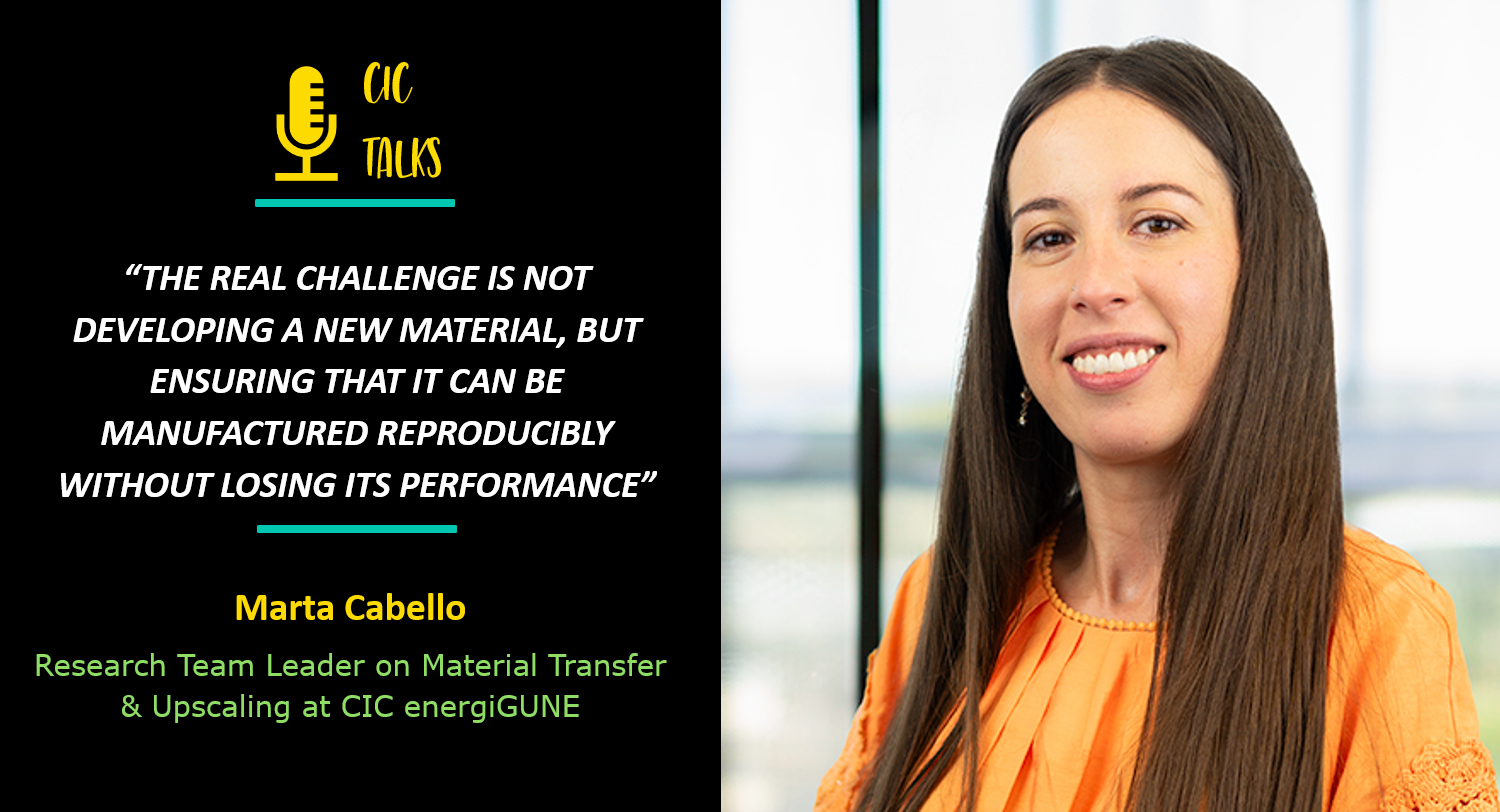
When a material is developed in the laboratory, work is usually carried out with very small quantities and under highly controlled conditions. However, when production is scaled up, the process no longer behaves in exactly the same way: temperature gradients appear, mixing differences arise, effective reaction times change, and variations in mass transfer may occur. All these factors can directly affect critical material properties, such as chemical homogeneity, morphology, particle size distribution, crystallinity or the presence of impurities. In batteries, even small changes in these properties can translate into significant differences in electrochemical performance.
The major challenge of scale-up is to ensure that the material maintains the same electrochemical performance when moving from a few grams to hundreds of grams or even kilograms. It is not simply a matter of producing a larger quantity, but of understanding and reproducing the entire process consistently in order to obtain a material with the same quality and performance as the one produced at laboratory scale.
That is why scale-up is a critical phase in battery development. Validating that a material retains its behaviour as production increases helps reduce technological risk and brings innovation closer to real industrial application.
The main challenge is to ensure process robustness and reproducibility when the operating scale changes.
In practice, as mentioned above, parameters that are perfectly coupled in the laboratory cease to be equivalent when the process is scaled up. This means that operating conditions have to be redefined, which often requires a significant investment of time and financial resources before a robust process can be achieved. In addition, further industrial requirements come into play: maintaining a homogeneous composition, avoiding secondary phases and ensuring batch-to-batch consistency, since small deviations can affect safety, lifetime and performance.
Therefore, scale-up is not simply a matter of increasing volume, but of re-engineering the process to produce the material under different physical conditions.
The most critical parameters depend on the technology and the material being developed, but some are common to most processes. Reaction time, reaction rate, mixture homogeneity, synthesis atmosphere and calcination conditions all directly influence properties such as particle size, composition, crystallinity or material morphology.
The challenge lies in controlling all these variables so that the material obtained at a larger scale is equivalent to the one developed in the laboratory. Only in this way is it possible to ensure that it maintains the same electrochemical performance and that the process is reproducible, which is an essential requirement for future industrialisation.
Next-generation materials offer enormous potential to improve the energy density, autonomy and sustainability of batteries, but they are also much more sensitive to manufacturing conditions. From a scale-up perspective, in many cases there is a disconnect between what is reported in the literature and what is industrially viable. Materials with very high performance are often published using highly complex synthesis routes, involving multiple steps or reagents that are manageable at laboratory scale in milligram quantities, but which can have a very significant economic and logistical impact at kilogram scale. This directly affects process scalability, since in some cases the cost and complexity of manufacturing may become incompatible with the real benefit that the material provides in application. Materials such as lithium-rich compounds or silicon-containing composites require very precise control of synthesis in order to maintain their properties as production scale increases.
For example, in the case of silicon, one of the main problems is the loss of homogeneity in the distribution of silicon within the composite, which can lead to locally enriched or depleted areas. This has a direct impact on electrochemical behaviour, since silicon undergoes significant volumetric expansion during cycling, and any heterogeneity translates into local mechanical stresses and accelerated degradation.
In lithium-rich materials, thermal treatment is not a secondary step: it is a decisive stage. An inadequate thermal profile can alter structural ordering, promote undesired phases or increase defects, causing the material to stop behaving as a functional Li-rich material. In that case, we are not simply dealing with a loss of performance, but with the loss of the very concept of the material. In addition, these next-generation materials often present further challenges related to their stability, processability or integration into the cell. That is why validation is an essential stage. It is not enough to demonstrate that a material works; it is also necessary to verify that it can be produced consistently and that it behaves as expected under conditions close to those of an industrial application.
A material may present excellent properties from a chemical point of view, but that does not guarantee that it will deliver high performance when integrated into a battery. Its processability is just as important: it must maintain its stability during slurry and electrode manufacturing processes, and it must be compatible with the other cell components without losing performance.
For this reason, validation does not end with material synthesis. It is essential to verify its behaviour throughout all manufacturing stages and to assess its performance in a full cell. Only then is it possible to determine whether a technology is truly ready to make the leap from the laboratory to an industrial application.
One of the most common mistakes is to think that scale-up simply consists of directly extrapolating the laboratory calculations or conditions in order to increase production. In practice, it does not work that way: when the scale changes, the heat and mass transfer regimes and the effective kinetics of the process also change. In addition, the equipment is not simply a “larger” version of the laboratory equipment, but a different system, designed to operate under another regime and requiring specific adaptation of the process parameters.
Another frequent limitation is focusing only on the properties of the material and not on process reproducibility. For a technology to reach industry, it is not enough to obtain a good result once; it is essential to demonstrate that the material can be manufactured consistently, with the same quality and performance batch after batch.
In the coming years, we will see a strong focus on materials capable of increasing energy density, improving safety and reducing dependence on critical raw materials. In this context, technologies such as lithium-rich materials, silicon anodes and sodium-based chemistries will continue to gain prominence, as they respond to some of the industry’s main needs.
However, the success of these technologies will not depend solely on their performance in the laboratory. It will be essential to develop synthesis and manufacturing processes that make it possible to produce these materials at scale, reproducibly, sustainably and at a competitive cost, while also ensuring their integration into cells with reliable performance.
For this reason, research will increasingly move towards an integrated approach, in which the development of new materials goes hand in hand with their scale-up, validation and transfer to industry. Reducing the time between a scientific discovery and its commercial application will be one of the sector’s major challenges.
At CIC energiGUNE, we support companies in one of the most complex phases in the development of a new technology: the transition from a laboratory recipe to validation under conditions that are representative of industry. Our goal is to reduce the uncertainty associated with scale-up by optimising synthesis processes and verifying that the material maintains its properties as production increases.
To do this, we work not only on material manufacturing, but also on its processing and integration into a cell. This allows us to evaluate its behaviour under conditions closer to a real application and to identify potential limitations before the company undertakes larger-scale investments.
In this way, we help our partners make decisions based on solid technical evidence, reducing development times and minimising technological risk before moving towards industrialisation or large-scale production.
If you want to know the latest trends in energy storage and new developments in research, subscribe.

If you want to join a top-level team, collaborate with specialists in multiple disciplines or tell us about your concerns, don't think twice...