More energy, less weight: why drones need different batteries
Specific energy is probably the parameter that best explains the growing interest in drones within the battery sector.
In a stationary application, adding several kilograms to an energy storage system may have a relatively limited impact. Even in an electric vehicle, there is some scope to increase battery pack size in exchange for greater range.
In an aircraft, this trade-off is much more restrictive. Every kilogram allocated to the battery competes directly with cameras, sensors, communication systems, inspection tools, cargo and other payload items.
A lighter battery can be used to increase range while keeping the aircraft´s weight unchanged or, alternatively, to carry a larger payload while maintaining a similar flight time. This relationship is particularly clear in commercial applications.
In drone delivery, for example, a few additional minutes of flight can extend a platform´s service radius and allow it to cover a larger area from the same base. Reducing battery weight can also increase the amount of cargo carried, while shortening charging time can improve aircraft utilization throughout the day.
Infrastructure inspection follows a similar logic. A drone used to inspect power lines may carry high-resolution cameras, thermal sensors, LiDAR systems or other instruments. Greater endurance allows it to inspect more kilometres before returning to a charging base and can reduce the number of interruptions needed during an operation.
When these platforms are used to monitor networks stretching over thousands of kilometres, improving range and endurance can have a direct impact on the productivity of inspection and maintenance operations.
All this explains why drones could become one of the first markets for new high-specific-energy technologies. Lithium-ion batteries continue to dominate many current platforms because of their combination of energy, power and industrial maturity. However, the sector´s requirements are encouraging the introduction of new solutions.
Silicon-rich anodes are one of the clearest examples. This technology aims to increase the amount of energy stored per unit of mass compared with conventional configurations based primarily on graphite, making it particularly attractive in applications where every gram counts.
Lithium metal represents another development pathway with the potential to achieve even higher specific energies. Various developers are already demonstrating cells and packs intended for aviation and drone applications with values significantly higher than those of many conventional commercial batteries.
These results must be interpreted with caution. Demonstrating high performance does not automatically mean having a technology that can be manufactured in millions of units at low cost and with a lifetime of thousands of cycles.
But this is precisely where one of the most interesting aspects of drones for the battery industry lies.
Certain professional applications may accept a higher cost per kWh if the battery enables longer flights, inspection of more infrastructure, greater payload capacity or an operation that would otherwise be unfeasible. This could make drones an entry market for new technologies before they achieve the cost or scale required to compete in much higher-volume sectors.
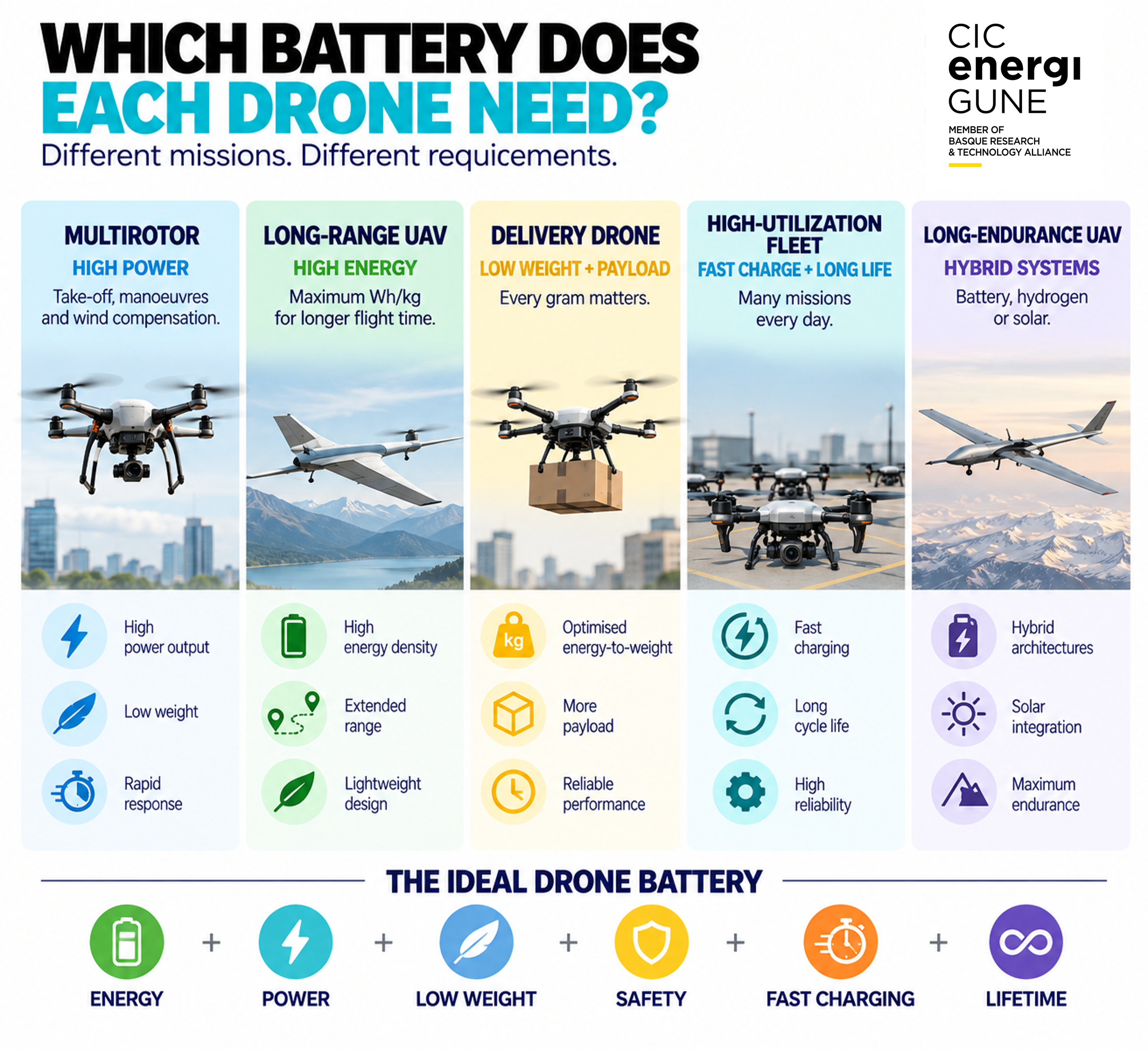
And specific energy is not the only requirement. Multirotor drones also need high power during take-off, acceleration, changes of direction and compensation for wind. A battery with high energy capacity but unable to deliver high power would be of limited use.
The optimal technology must therefore strike a balance between specific energy, power, weight, safety and degradation.
From cell to system: new opportunities for the battery industry
The growth of drones creates opportunities that go far beyond developing a cell with more Wh/kg. As these aircraft move from individual flights to becoming part of professional fleets, the battery also becomes a determining factor in the economics of operations.
In a parcel delivery fleet, for example, the objective is not only to maximize the duration of a single flight. The number of operations each aircraft can complete during the day also matters. The same applies to drones used to inspect energy infrastructure. System productivity will depend on how many kilometres can be inspected, how long the drone remains on the ground and how reliably it can repeat operations. This increases the importance of parameters such as fast charging, automated battery swapping, cycle life, thermal behaviour and state-of-health diagnostics.
A pack that can be recharged quickly can reduce the number of batteries needed to keep a fleet operating. An automated swapping system can allow a drone to land, replace its battery and take off again with minimal human intervention.
The Battery Management System is also becoming increasingly important. Rather than merely monitoring voltage and temperature, the BMS can become a tool for estimating the energy actually available, predicting degradation and determining whether a battery can safely complete a given operation.
In an increasingly autonomous system, this information can be integrated into flight planning itself. A drone inspecting a power line could simultaneously consider state of charge, battery state of health, remaining distance, sensor weight, wind and temperature to determine how far it can continue before returning to base.
Safety is another major area of development. Increasing the amount of energy stored in an ever-lighter system requires careful management of temperature, mechanical protection, thermal propagation and operation under variable environmental conditions. In addition, the market is likely to become increasingly segmented.
A small multirotor designed to inspect an electricity pylon may prioritize high power and manoeuvrability. A fixed-wing drone travelling long distances may place much greater value on maximum specific energy. A delivery aircraft may need to balance endurance, payload, fast charging and cycle life.
And platforms intended for very long-duration flights may adopt hybrid architectures combining batteries with other energy sources. This diversity creates opportunities in silicon anodes, lithium metal, advanced electrolytes, solid-state technologies, lightweight pack materials, thermal management, BMS and power electronics, as well as in manufacturing, validation and application-specific design for aviation.
One of the most interesting aspects may be precisely the role of drones as a bridge between the laboratory and subsequent markets for electric aviation. Their packs are relatively small, and initial volumes may be lower than in the automotive industry, while the value of a performance improvement is very high. This makes it possible to validate advanced technologies under real-world conditions before attempting to introduce them into larger aircraft platforms.
For this reason, the relevance of the drone industry to the battery sector probably should not be measured solely by the GWh it eventually consumes. Its importance may also lie in another dimension: the ability to turn relatively small battery improvements into major improvements in overall system performance.
A few extra minutes of flight can make it possible to inspect several more kilometres of power line. A weight reduction can free up capacity for a better camera, an additional sensor or a heavier parcel. Faster charging can increase the number of daily operations across an entire fleet.
Ultimately, the question is no longer simply which battery can make a drone fly, but which combination of energy, power, weight, safety, fast charging and service life can maximize productivity in each application.
Answering that question could make drones one of the most interesting markets for accelerating the transition of the next generations of batteries from technology development to real commercial applications.