A battery does not start ageing when we notice that it no longer lasts as long. From its very first cycles, every operating condition leaves small traces in its materials, interfaces and components. Over time, these changes can accumulate, leading to capacity loss, increased resistance and changes in how the battery responds to demanding conditions.


Understanding how these mechanisms arise and interact is essential for developing more durable, reliable and safe energy storage systems.

From the outside, battery ageing may seem like a straightforward process: after a certain number of cycles, the battery stores less energy and no longer delivers the same performance. Yet what the user perceives is merely the outward manifestation of a much more complex evolution. Inside the cell, chemical, electrochemical, thermal and mechanical transformations take place simultaneously, affecting the electrodes, electrolyte and interfaces. These processes do not necessarily progress at the same rate or stem from a single cause.

This is why speaking of “degradation” as though it were one single phenomenon can be misleading. The growth of interfacial layers, metallic lithium deposition, electrolyte degradation, changes in electrode volume and structural damage can coexist and reinforce one another. Temperature and operating conditions also influence the rate at which some of these processes evolve, meaning that two identical batteries can reach the same point in their service lives with very different internal states.

Consequently, chronological age or cycle count tells only part of the story. To truly understand why a battery has lost performance, we need to reconstruct how it has been used, what changes have occurred inside it and how those changes affect its behaviour. Reading the signs of ageing in this way allows us to move beyond observing a symptom to identifying its origin.

Every use leaves a trace inside the battery

Battery operation involves ion movement, charge transfer and reactions at the interfaces between different materials. This normal operation gradually changes the state of the cell. Some of these changes are inherent to its operation, while others may become more pronounced under more demanding conditions. Crucially, the outcome depends not only on how much a battery is used, but also on how it is used.

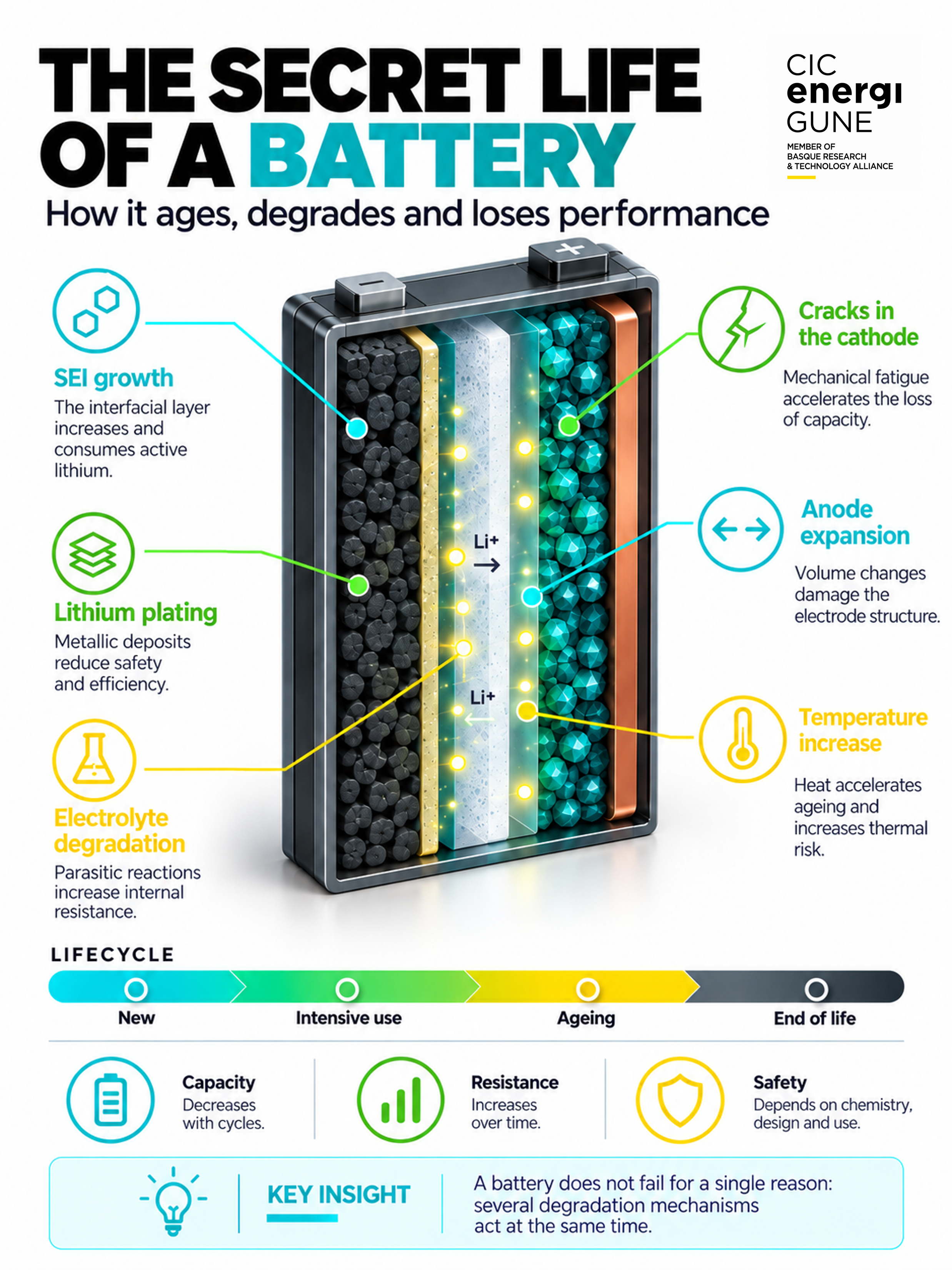
One phenomenon associated with ageing is the growth of the solid electrolyte interphase (SEI), an interfacial layer that forms on the anode and whose evolution can progressively consume active lithium. Although its initial formation is necessary for the stable operation of many lithium-ion batteries, continued growth reduces the amount of lithium available to participate in charge and discharge cycles.

Other mechanisms may occur alongside it, such as lithium plating, in which lithium is deposited as metal on the anode surface instead of being properly inserted into its structure. This phenomenon can reduce battery efficiency and, under certain conditions, affect safety. Electrolyte degradation is another relevant process, as various parasitic reactions can consume active components and contribute to a gradual increase in internal resistance.

Ageing also has a mechanical dimension. The materials that make up the electrodes undergo volume changes during charging and discharging, and repeated expansion and contraction can gradually alter their structure. At the anode, these changes can affect the integrity of the electrode and its interfaces, while at the cathode, mechanical fatigue can encourage crack formation and accelerate performance loss.

The cell is therefore not a static system. Its materials change over time, and these transformations can alter contact between components, ion and electron transport pathways and, ultimately, the overall behaviour of the battery.

Temperature introduces another decisive variable. Rather than always acting as an independent degradation mechanism, it can accelerate many of the reactions already taking place inside the cell. Prolonged exposure to high temperatures can promote parasitic processes, increase the rate of ageing and reduce available thermal safety margins, while other temperature conditions can affect the kinetics of electrochemical reactions.

This is why a battery’s thermal history matters just as much as its cycling history. Similarly, state of charge, cell chemistry, format, applied currents and depth of cycling all influence how the battery evolves over time. A single capacity measurement or a given number of cycles is therefore insufficient to describe its state of health fully.

This perspective changes how we understand service life. Instead of imagining an identical trajectory for every cell, it is more useful to consider different usage histories that leave different accumulated traces. A battery exposed to certain thermal and electrical conditions over several years may evolve differently from another battery using the same technology but operating under a different profile. In this sense, degradation is a physical memory of what has happened throughout the cell’s life.

A battery does not age in just one way

The first sign commonly associated with ageing is capacity loss. But it is not the only one. Internal resistance may increase over time, limiting the cell’s ability to deliver or accept power, while certain changes in materials and interfaces may alter its behaviour under normal or extreme operating conditions.

Capacity, resistance and safety are related but distinct dimensions. Analysing them together provides a much more complete picture of a battery’s actual condition than simply measuring how much energy it can store after a given number of cycles.

This matters particularly because a battery does not necessarily fail for a single reason or always follow a linear path from “new” to “end of life”. Different degradation mechanisms can act simultaneously, with varying intensity and in different parts of the cell. Some progressively reduce the amount of available active material; others increase internal resistance; and still others can change the structure of the electrodes or the stability of the interfaces.

Likewise, performance loss does not automatically mean that a battery has become unsafe. A degraded battery is not necessarily a dangerous battery. The key is to understand which mechanisms are present, how far they have progressed and how they affect the battery’s response in each application and under different operating conditions.

For this reason, safety assessments must also consider the cell’s ageing state and its electrochemical and thermal history. Comparing batteries with different states of charge, chemistries, formats and ageing levels helps explain why they may respond differently to the same stimulus.

This relationship can be investigated through tests specifically designed to expose cells to more demanding thermal, electrical or mechanical conditions than they would encounter during normal operation. Controlled heating, overheating, overcharging, overdischarging, external short circuits and certain penetration and compression tests make it possible to study the onset and progression of different failure modes.

During these tests, variables such as temperature, pressure, gas evolution, voltage and current provide information on how the cell responds and on the differences associated with its chemistry, design and previous condition. Techniques such as accelerating rate calorimetry (ARC) also allow thermal behaviour to be studied under controlled conditions, including phenomena such as thermal runaway.

The aim is not simply to push a battery to failure. What truly matters is understanding when the process begins, which warning signs appear, how it develops and how that response relates to the cell’s previous history.

This approach is especially important for mobility and stationary energy storage applications, where reliability over years of operation is just as important as initial performance. Understanding the relationship between degradation, usage conditions and the response to demanding situations makes it possible to define operating limits more accurately, compare technologies and detect behaviours that might go unnoticed if only available capacity were assessed.

Reading the traces to extend service life and improve safety

When a battery has lost performance, measuring its capacity tells us how much it has changed, but not necessarily why. Two cells may show similar capacity loss yet have reached that point through entirely different mechanisms. Reconstructing the cause requires combining different levels of diagnosis and examining both the electrochemical response and the structure and materials of the battery.

Analysis can begin with non-invasive techniques that provide information about the cell interior without dismantling it. X-ray microtomography, for example, makes it possible to examine certain structural features and detect internal changes while keeping the battery intact.

When more detailed diagnosis is needed, controlled cell opening provides direct access to the components and enables cylindrical, prismatic or pouch cells to be studied under appropriate conditions. Subsequent analysis of electrodes, electrolytes, interfaces and other components can reveal deposits, structural changes, products of unwanted reactions or other indicators that help identify the mechanisms responsible for performance loss.

Advanced characterisation techniques complement this information by linking observed material changes to the battery’s state of health and failure modes. In this way, post-mortem analysis becomes more than an “autopsy” of a cell that has already failed: it is a tool for reconstructing its ageing history.

This research is supported by electrochemical testing laboratories, climatic and safety chambers, and dedicated equipment for analysing the thermal response of cells. The true diagnostic value emerges when all this information is interpreted together: what the materials reveal, how performance has evolved, the operating conditions and the response to safety tests.

Comparing state of charge, chemistry, format and ageing level, and linking the observed response to the electrochemical and thermal history, turns experimental data into useful information for diagnosis and for comparing energy storage solutions. Depending on the validation objective, these tests can also be conducted in accordance with specific standards relating to battery safety and transport.

At CIC energiGUNE, this integrated approach is applied to both commercial technologies and emerging systems. Its degradation and safety capabilities cover lithium-ion and sodium-ion batteries, metal–air and lithium–sulphur systems, zinc- or nickel-based chemistries, batteries with solid, polymer or ceramic electrolytes, as well as supercapacitors and hybrid systems.

The underlying principle is similar in every case: identify the causes of degradation, validate behaviour under representative conditions and generate knowledge that makes it possible to anticipate risks and improve reliability.

The ability to reproduce real-world conditions, combine controlled testing with advanced diagnostics and draw directly applicable conclusions allows researchers to go beyond a simple description of failure. This information can help identify suitable technologies for each application, optimise operating conditions, extend service life, reduce costs associated with premature system replacement and accelerate the development of new products through faster cycles of validation and learning.

Understanding degradation therefore goes far beyond explaining why a battery has aged. Every cell carries traces of its own history, and learning to read them allows us to turn ageing into a source of information for designing more robust, reliable and safe energy storage systems.

Much of a battery’s life unfolds where we cannot see it. Its materials, interfaces and components record the effects of every cycle, every temperature and every operating condition. Understanding how these signs evolve enables us to move from reacting to a loss of performance to anticipating how the cell may continue to change. The real opportunity is not to prevent ageing entirely, but to understand it well enough to make batteries more durable, reliable and safe throughout their service lives.

Cookies on this website are used to personalize content and advertisements, provide social media features, and analyze traffic. You can get more information and configure your preferences HERE