

FIND THE CONTENTS THAT INTEREST YOU
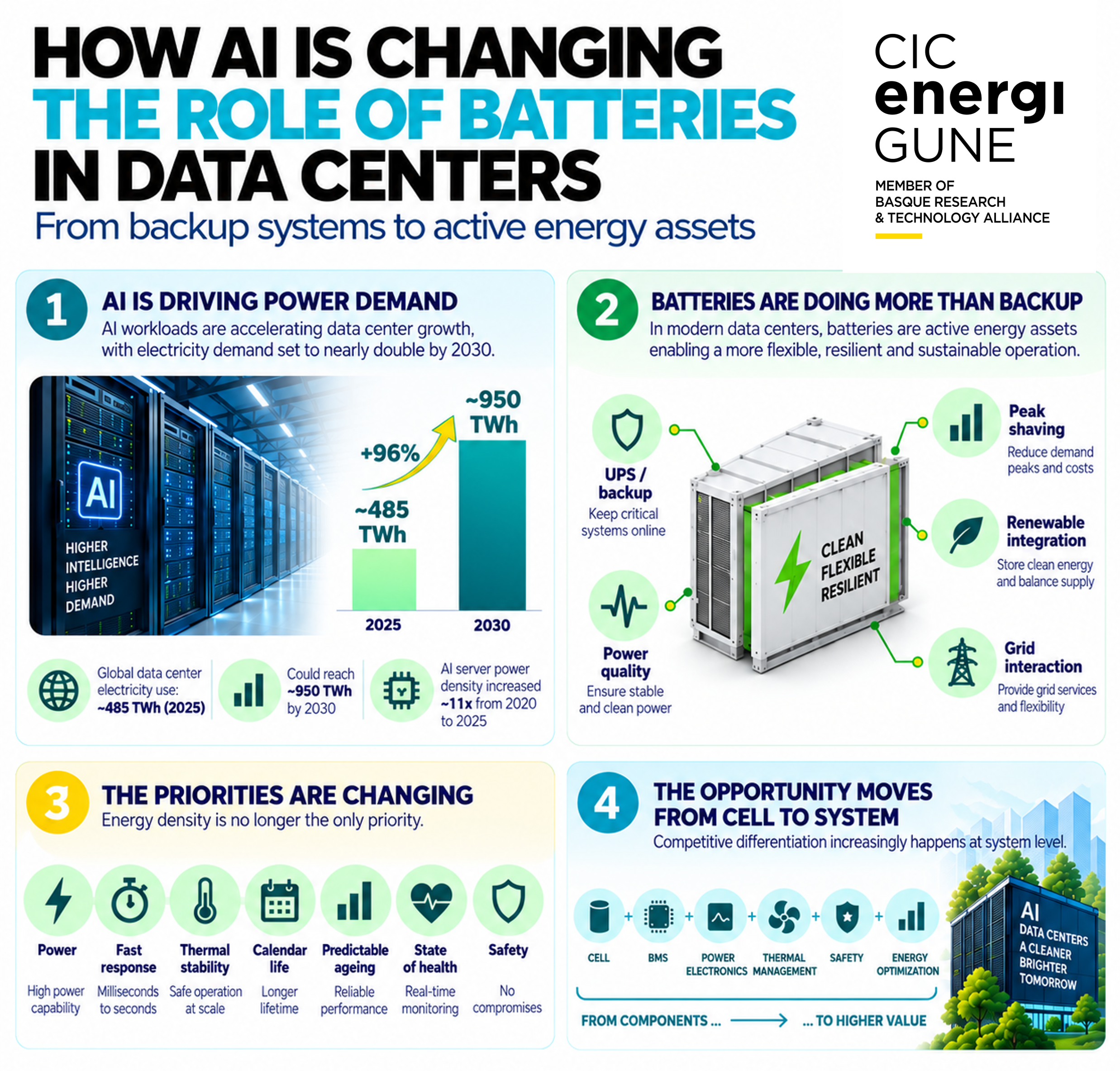
According to figures compiled in the CIC energiGUNE white paper, global data center electricity consumption reached approximately 485 TWh in 2025 and could rise to around 950 TWh by 2030, equivalent to nearly 3% of worldwide electricity demand. AI-focused data centers are also expected to grow considerably faster than the sector as a whole.
For the battery industry, however, the opportunity does not arise solely from this increase in electricity consumption. The more significant shift lies in the evolution of the data center´s own energy infrastructure.
Traditionally, batteries have been used primarily as part of uninterruptible power supply (UPS) systems, providing electricity for the seconds or minutes needed to maintain operations until an alternative power source, usually a generator, takes over. This function remains critical, but it is beginning to coexist with other needs related to power quality, peak management, renewable energy integration and, potentially, interaction with the electricity grid.
This evolution is creating a wider range of opportunities for battery manufacturers, materials developers, power electronics suppliers and companies specializing in management and diagnostic systems.
One of the factors most profoundly reshaping data center electrical infrastructure is the increase in power density associated with new artificial intelligence workloads.
The accelerators used to train and run advanced models make it possible to concentrate ever-greater computing capacity within a limited space. As a result, electricity consumption and heat generation are also becoming more concentrated. The report notes that the power density of AI servers increased approximately elevenfold between 2020 and 2025 and could rise substantially again in the coming years.
This shift affects the facility´s entire electrical architecture. Transformers, switchgear, distribution systems, UPS units, power electronics, cooling systems and batteries must all be capable of handling increasingly large power flows. AI workloads can also fluctuate rapidly, increasing the value of technologies that can respond almost instantaneously.
In this context, the criteria used to select a battery can differ considerably from those commonly applied in electric mobility. Maximum energy density is no longer necessarily the top priority. In certain data center applications, available power, response speed, efficiency, thermal stability, calendar life, predictable degradation and the ability to assess the battery´s actual condition accurately may be more important. This also contributes to market segmentation.
A Battery Backup Unit located at rack or row level must combine high power, a compact footprint and rapid response. Its proximity to IT equipment also places greater demands on thermal management, fault detection and safety.
A centralized UPS system, by contrast, has a different operating profile. The battery may spend much of its life at a high state of charge and undergo relatively few deep discharges. The critical question is not simply how many cycles it can deliver, but whether it will still be able to supply all the required power after several years of standby operation. Calendar life, the predictability of ageing and state of health therefore become particularly important.
Finally, a facility-level Battery Energy Storage System can perform additional functions. Besides contributing to resilience, it can be used to reduce demand peaks, improve the integration of renewable generation or support on-site energy management. In this case, parameters such as round-trip efficiency, cycle life, usable depth of discharge and degradation-related costs become particularly relevant. The implication is clear: there is probably no single battery technology that is optimal for the entire sector.
The report outlines a scenario in which established technologies such as lead-acid and different lithium-ion variants may coexist with solutions including LFP, NMC, sodium-ion, high-power lithium technologies, zinc-based systems, supercapacitors and flow batteries. Their positioning will depend on the required combination of power, duration, safety, service life, available space and cost.
The evolution of data centers is expanding the opportunity far beyond cell manufacturing.
In mission-critical infrastructure, battery chemistry matters, but it does not determine system reliability on its own. Thermal management, Battery Management Systems, power electronics, fire protection, fault detection and predictive diagnostics are equally important. Indeed, the report suggests that understanding a battery´s actual condition and ensuring its availability may be more valuable than maximizing its energy density. This creates significant opportunities for advanced BMS development and diagnostic tools.
A battery intended for backup may remain virtually unused for extended periods, yet it must respond correctly when an incident occurs. Knowing its state of charge is therefore not enough. Its state of health, genuinely available power and degradation trajectory must also be estimated. This requirement becomes even more complex when the battery is no longer used exclusively for backup.
If the system also participates in peak shaving, renewable energy integration or demand management, the operator must strike a balance between using the battery and retaining enough capacity to guarantee its primary resilience function. The white paper identifies this as an optimization problem: how much additional value can be extracted from the battery without compromising the mission-critical function for which it was installed? The industrial opportunity is thus progressively shifting toward integration.
As power requirements increase, the battery must be designed in conjunction with the power electronics, thermal system and electrical infrastructure. The report indicates that competitive differentiation may arise at system level by combining electrochemistry, electronics, thermal management, digital intelligence, safety and energy optimization.
Hybrid architectures may also emerge. The fastest fluctuations could be handled by very-high-power systems, while other batteries provide conventional ride-through capability and higher-capacity systems supply storage over longer periods. This separation would allow different technologies to operate within the ranges best suited to their characteristics.
At facility level, another opportunity is emerging: turning part of the storage capacity into an energy management asset.
Large data centers are becoming increasingly significant loads on electricity grids and, in some regions, access to new grid connection capacity may constrain the development of new projects. In this context, temporarily reducing peak imported power can create value even without significantly changing annual electricity consumption.
The report estimates that approximately 20–25 GW of battery storage capacity could be installed in data centers worldwide by 2030, although using this capacity for purposes beyond backup will depend on regulatory and operational conditions. Resilience will remain the priority in any case. Any additional use will need to preserve sufficient state of charge, available power, service life and redundancy.
For this reason, the competitiveness of data center solutions can hardly be assessed solely on their price per kWh. Total Cost of Ownership will need to be considered, including maintenance, replacements, efficiency, cooling, space, degradation and the potential cost of unavailability.
The opportunity created by the growth of data centers, therefore, is not simply about selling more batteries. It is about developing storage systems specifically adapted to an increasingly powerful, critical and complex digital infrastructure.
The question is no longer simply which battery can provide backup, but which combination of electrochemistry, power, safety, service life, diagnostics and integration can most efficiently secure the energy supply of the next generation of data centers. For the battery industry, answering that question could become one of the most significant technological and industrial opportunities associated with the growth of artificial intelligence.
If you want to know the latest trends in energy storage and new developments in research, subscribe.
If you want to join a top-level team, collaborate with specialists in multiple disciplines or tell us about your concerns, don't think twice...