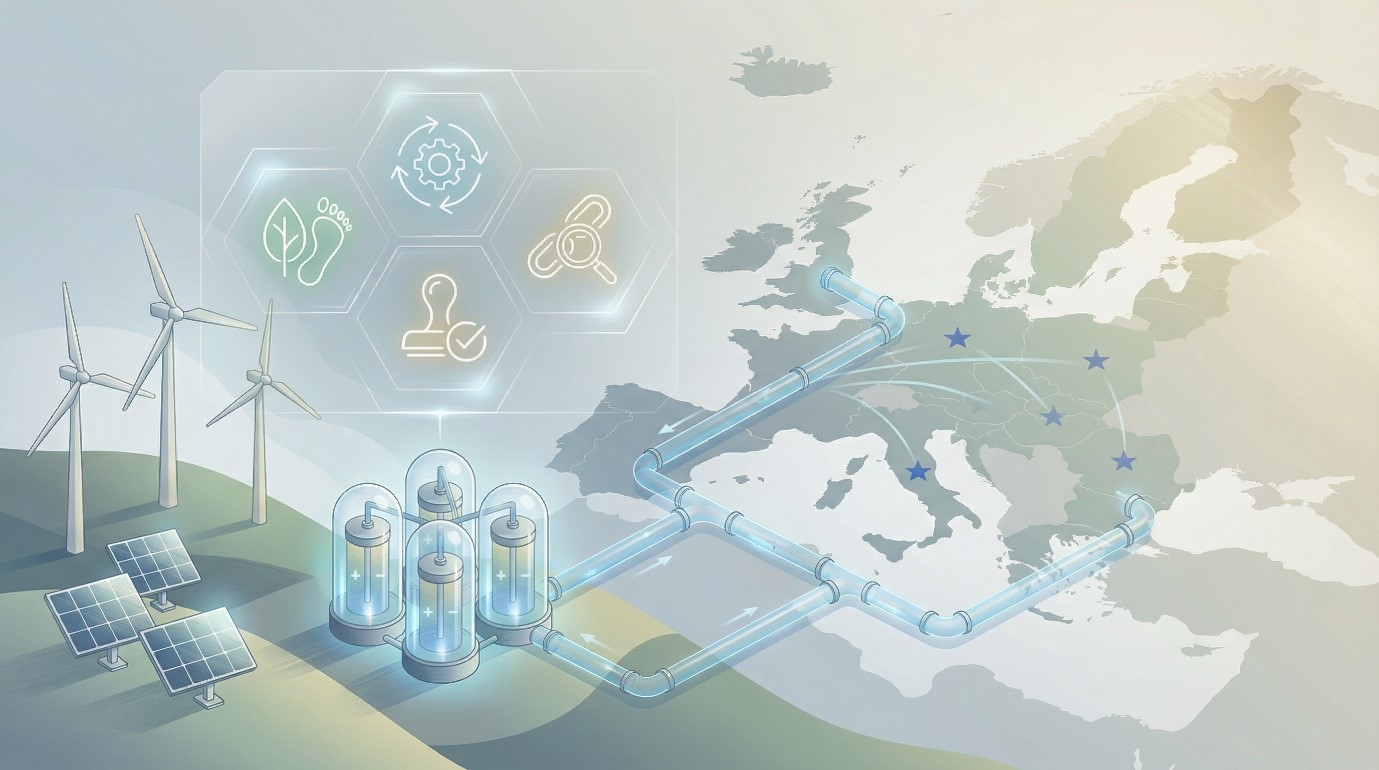

Within this process, and following a path already familiar in other industrial sectors, the concept of the digital hydrogen passport is beginning to consolidate. This tool is designed to provide traceability, transparency, and legal certainty to a market that is still incipient but expected to grow rapidly.
Although its regulatory development is not as advanced as that of the battery passport, the approach is similar: to establish a harmonised system, applied progressively, that allows the unequivocal identification of how and where the hydrogen circulating in the European market is produced, which energy sources are used, and what environmental impact it entails. In this way, the passport emerges as a key element to avoid market distortions, combat greenwashing, and ensure that hydrogen genuinely contributes to the EU’s climate objectives, and not merely in a nominal sense.
A step further: towards a Hydrogen Digital Product Passport
This debate has recently taken a further step with the publication of the Viewpoint “Hydrogen Digital Product Passport: Unlocking Trust and Transparency for a Global Low-Carbon Future” in Environmental Science & Technology, co-authored by Prof. Paramaconi Rodríguez, Ikerbasque Research Professor at CIC energiGUNE.
The article proposes a Hydrogen Digital Product Passport (HDPP) as a standardised and verifiable digital framework capable of integrating sustainability, Life Cycle Assessment, certification and regulatory information across the hydrogen value chain. Its implementation could play a key role in increasing transparency, facilitating international trade and providing greater certainty for companies, governments and investors.
Read the open-access Viewpoint in Environmental Science & Technology.
A model inherited from the battery passport, adapted to energy logic
The conceptual similarity between the hydrogen passport and the battery passport is not coincidental. Both respond to the same regulatory logic, based on life cycle control, digitalisation of key information, and the creation of trust in strategic markets. In the case of hydrogen, however, the challenge is greater in certain respects, since it is not an individual physical product, but an energy flow that is produced, transported, and consumed in batches, often crossing borders and very different energy systems.
This difference explains why the focus of the hydrogen passport is less on materials and more on the process, particularly on the energy source used and the emissions associated with each kilogram produced. Progressively, this system will make it possible to classify hydrogen according to its environmental performance, facilitate access to public incentives, and, in the medium term, establish maximum emission limits that will condition the viability of certain projects. As occurred with batteries, this regulation not only structures the market, but also raises the competitive bar, favouring those actors capable of demonstrating, with verifiable data, the real sustainability of their operations.
Added to this logic is an increasingly relevant geopolitical and commercial dimension. In a scenario in which Europe expects to import a significant share of the hydrogen it will consume in the future, the passport becomes a common language that allows comparison of production carried out under different regulatory frameworks. In this way, it prevents imported hydrogen from competing at an advantage over hydrogen produced within European territory by not internalising the same environmental requirements, reproducing a scheme already observed in the battery sector.
In addition, the inherited model introduces a new culture of data management in the energy sector. The passport does not merely certify a static attribute, but accompanies hydrogen throughout its value chain, integrating technical, environmental, and administrative information. This forces the different actors to cooperate more closely, share information, and professionalise sustainability management, transforming a traditionally opaque market into one that is progressively more transparent and traceable.