Electrolytes, membranes and stacks: performance depends on the entire system
One of the areas with the greatest potential is the development of organic molecules as active materials.
Unlike metals, these molecules offer significant design flexibility. Their structure can be modified to tune properties such as redox potential, solubility or chemical stability, opening the door to electrolytes tailored to different operating requirements.
However, this flexibility also introduces new challenges. Chemical degradation, crossover, viscosity, electrochemical stability and compatibility with the other components can determine whether a promising molecule ultimately performs effectively inside a battery.
This highlights one of the technology´s main challenges: optimising a single property in isolation is not enough. Improving solubility may affect other electrolyte characteristics; changing the chemistry may require rethinking the membrane; and a solution that works in a laboratory cell may behave differently when integrated into a larger system.
At CIC energiGUNE, we address this problem from an approach that connects the design of new active molecules with their behaviour inside the battery, with particular emphasis on alternatives that can enable more stable and sustainable systems with lower dependence on critical raw materials.
A similar challenge arises with membranes. Their role is to enable the ionic transport required for battery operation while limiting the transfer of active species from one electrolyte to the other. Achieving this balance is complex: high resistance reduces efficiency, while excessive permeability increases crossover and can accelerate performance loss.
In addition, membranes must retain their properties for years while in contact with electrolytes that may present highly demanding chemical conditions. They must therefore simultaneously optimise cost, selectivity, conductivity and chemical stability.
This is another area in which there is significant scope to move beyond conventional solutions. At CIC energiGUNE, we investigate new membrane concepts specifically adapted to the chemistry and operating conditions of each battery, including alternatives aimed at reducing costs and moving towards non-fluorinated materials.
The key lies precisely in this adaptation: there is not necessarily a single optimal membrane for every redox flow battery. Its design must respond to the electrolyte, the chemical environment, species transport and the expected system performance.
The same applies to the stack, where the electrochemical conversion takes place.
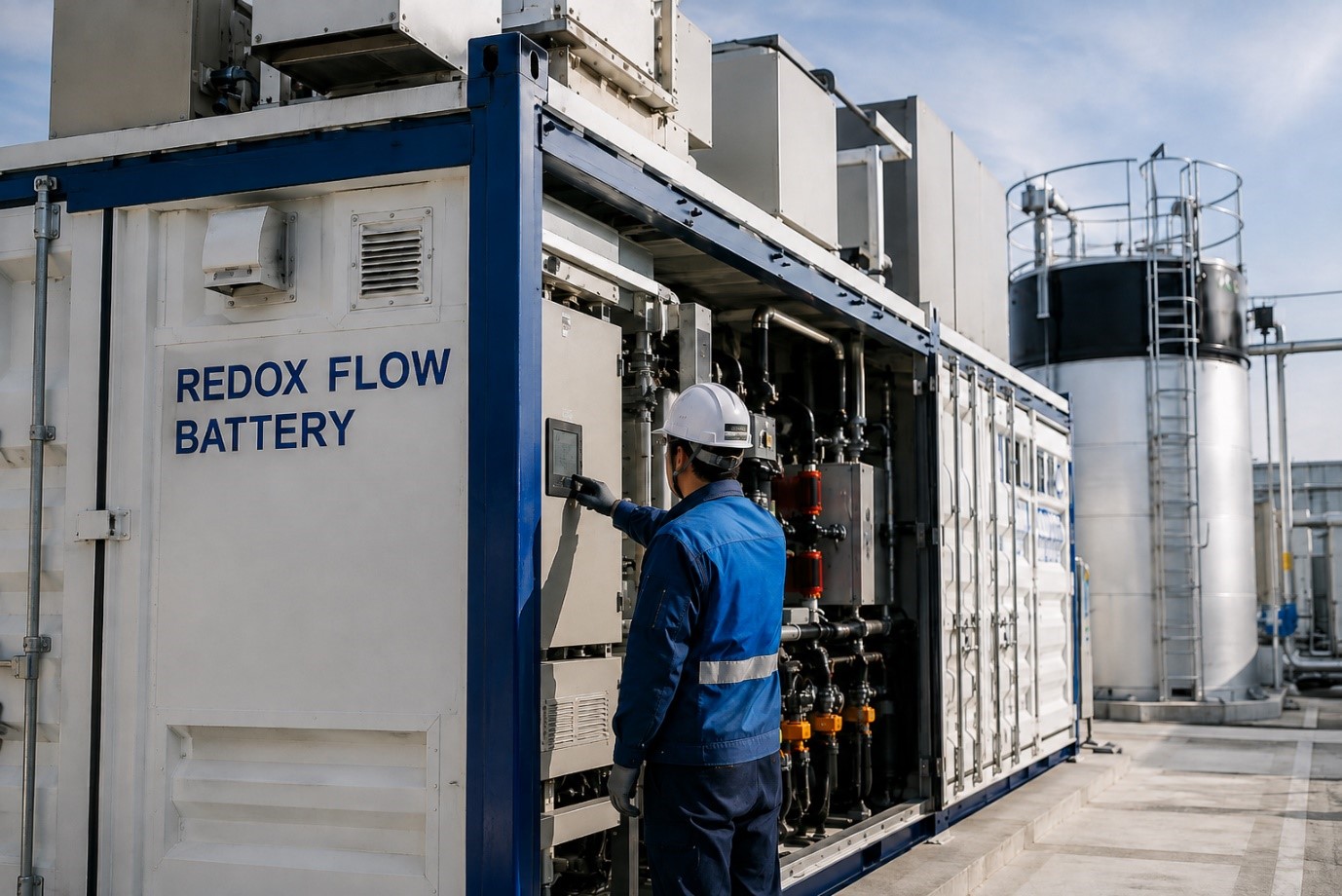
The electrolyte represents only part of the total cost of a redox flow battery. Membranes, electrodes, bipolar plates, pumps, tanks, piping, sensors and power electronics all have a direct impact on CAPEX, performance and maintenance requirements.
Another priority is therefore to increase stack power density while simultaneously reducing manufacturing cost and complexity.
Bipolar plates are especially important. They must provide high electrical conductivity, chemical resistance and mechanical stability while remaining cost-competitive.
Here too, there are opportunities for innovation that go beyond optimising an isolated component. CIC energiGUNE works on new materials and configurations for stack components, with particular attention to their integration, performance and potential for manufacturing at larger scale.
This approach helps address one of the sector´s major bottlenecks: transforming components that perform correctly in the laboratory into solutions that are reproducibly manufacturable and integrable into progressively larger stacks.
Innovation in redox flow batteries does not, however, have to be limited to improving existing systems. It is also possible to question some of their starting assumptions: reducing vanadium consumption without losing the advantages of this chemistry; developing systems based on more abundant materials; or exploring single-flow architectures are among the strategies that could substantially change the cost structure and performance of future battery generations.
At CIC energiGUNE, we are exploring precisely concepts that combine alternative chemistries, new architectures and strategies aimed at reducing the use of critical raw materials, alongside new approaches to improving vanadium-based systems.
These are different routes, but they all address the same question: how can we preserve the advantages that make a redox flow battery attractive while eliminating the factors that currently hinder its competitiveness?
From strong electrochemical results to a competitive system
This is precisely where one of the greatest challenges for redox flow batteries lies: scale-up.
A strong electrochemical result obtained in the laboratory does not guarantee that the same behaviour can be maintained when the cell size increases, multiple units are assembled into a stack or all the components of a real system are integrated.
New phenomena emerge during scale-up. Non-uniform electrolyte distribution, pressure differences, parasitic losses, shunt currents, thermal management issues or cell-to-cell variations can significantly alter the performance observed at small scale.
Industrial development therefore requires different levels to be connected: molecular design, electrolyte formulation, membrane development, transport studies, cell validation, stack design and testing, modelling and analysis of the complete system.
This connection across scales is one of the distinctive elements of CIC energiGUNE´s approach. The work does not end when a promising material is identified: the centre´s different capabilities make it possible to study how its behaviour evolves as it moves from material to component, from component to cell and from cell to system, while also incorporating modelling and sustainability and cost analysis.
This perspective is particularly relevant in a technology where many of the main barriers emerge precisely during the integration process.
The next leap in redox flow batteries will probably not come from a single spectacular improvement, but from ensuring that electrolyte, membrane, electrodes, stack and balance of plant evolve in a coordinated way.
Redox flow batteries have already demonstrated that they can provide safe storage, high cycling capability and long service life. They must now show that these characteristics can be maintained in larger-scale systems manufactured consistently and at competitive cost.
This also means looking beyond the battery´s initial price. In long-duration storage applications, parameters such as degradation, total cycle count, efficiency, maintenance and service life have a decisive impact on the Levelized Cost of Storage (LCOS) and therefore on the real economics of the project.
There is therefore unlikely to be a single winning chemistry. Redox flow batteries should be understood as a complementary platform within a future portfolio of energy storage technologies. Where energy density or footprint are the main priorities, other solutions may be more suitable. But when long discharge durations, intensive cycling, safety, longevity and low degradation become decisive, their value proposition can be very different.
The challenge over the coming years will be to turn that technical advantage into an industrial advantage as well.