


FIND THE CONTENTS THAT INTEREST YOU
Just a few years ago, sodium-ion batteries seemed destined mainly for stationary energy storage and applications where energy density was not particularly important.
In 2026, that boundary is beginning to blur.
CATL has brought its Naxtra sodium-ion battery to 175 Wh/kg and, together with CHANGAN, unveiled a mass-production passenger car equipped with this technology in February 2026, with a claimed range of more than 400 kilometres. According to CATL, the vehicle was scheduled to reach the market in mid-2026. The company also suggests that, as the supply chain matures, this technology could evolve towards ranges of 500–600 kilometres. (CATL)
Stationary storage is progressing even faster. CATL and HyperStrong have signed an agreement to supply 60 GWh of sodium-ion batteries over three years, while CATL and Alfen have agreed to collaborate on the deployment of 5 GWh of sodium-ion storage in Europe.
Sodium can therefore no longer be regarded merely as a promising technology. It is entering a phase of industrialisation and commercial deployment, although its maturity still varies considerably depending on the application.
This also changes the question we should be asking.
It is no longer:
Can sodium replace lithium?
But rather:
Where does sodium make sense, and where do other chemistries still have the advantage?
One of the most frequently repeated arguments about sodium-ion batteries has always been their lower energy density compared with lithium-ion batteries.
This remains an important consideration, but the current situation is considerably more nuanced.
CATL´s Naxtra reaches 175 Wh/kg, while Farasis Energy has announced an energy-oriented Na-ion battery rated at 180 Wh/kg, specifically designed for medium-range electric vehicles, start-stop systems and energy storage.
These figures show just how close sodium-ion is moving to the territory traditionally occupied by LFP. Within its own technology portfolio, Farasis reports 180 Wh/kg for its sodium-ion solution, compared with 220 Wh/kg for its first-generation LFP and 240 Wh/kg for its second generation. Its mid-nickel NCM cells, intended for applications requiring higher energy density, range from 260 to 290 Wh/kg.
In any case, comparisons must be treated with caution. Manufacturers do not always report performance at the same level of integration—cell, module or pack—or under exactly the same conditions. Consequently, not all figures published on the market are directly comparable.
Moreover, gravimetric energy density does not tell the whole story. Volumetric energy density—how much energy can be stored within a given volume—is also a key variable, particularly in automotive and other applications where available space may be just as limiting as weight. However, manufacturers do not yet report Wh/L data consistently for these same sodium-ion and LFP solutions, making like-for-like comparisons difficult.
The current picture is therefore more interesting than a simple “sodium versus lithium” debate: sodium-ion is beginning to approach certain LFP solutions but remains below lithium chemistries specifically developed to maximise energy density.
And that difference is essential to understanding where it can genuinely add value.
Stationary energy storage remains one of the most natural applications for Na-ion batteries, but we are no longer talking only about future potential.
In an installation connected to a renewable energy plant, an industrial facility or the electricity grid, battery weight matters much less than it does in a car. Factors such as service life, safety, total system cost, raw material availability and thermal behaviour become far more important.
This is precisely where sodium offers particularly interesting characteristics.
At CIC energiGUNE, we have long highlighted raw material availability, sustainability and favourable thermal behaviour among the main strengths of Na-ion technologies. Sodium is also an abundant and widely distributed resource, helping to reduce exposure to some of the critical raw materials that currently shape the battery value chain.
And the market is already beginning to validate this proposition.
CATL has developed TENER Sodium specifically for energy storage and says that commissioning of its production lines is complete. The company plans to begin its first customer deliveries in China in September 2026, reach a cumulative 1 GWh before the end of the year and begin international deliveries in June 2027. (CATL TENER Sodium)
These developments are joined by the 60 GWh agreement with HyperStrong and the 5 GWh collaboration with Alfen for Europe.
For stationary storage, then, the question is no longer so much whether sodium makes sense, but in which projects and under what economic conditions it can compete with already mature LFP systems.
Low-temperature performance is emerging as one of the most interesting features of some new generations of sodium-ion batteries, although it is not an inherent property of every sodium-ion cell.
According to tests published by CATL, Naxtra retains more than 90% of its capacity at −40 °C, delivers almost three times the discharge power of an equivalent LFP battery at −30 °C and can continue supplying power at temperatures as low as −50 °C. These are manufacturer-reported figures, but they illustrate why low-temperature performance is becoming such a prominent part of the commercial strategy for Na-ion. These capabilities should be understood as the result of the overall cell design—electrode materials, electrolyte and interfaces—rather than simply a direct consequence of using sodium.
This introduces a different variable into the comparison between technologies.
A battery does not need to achieve the highest available energy density to be the best solution if the application must operate reliably at extremely low temperatures.
Vehicles used in cold regions, outdoor stationary systems and certain industrial applications could benefit particularly from this characteristic.
CATL is even taking this concept into hybrid architectures. Its multi-chemistry battery strategy includes a sodium-LFP configuration that specifically combines the low-temperature performance of Na-ion with another chemistry to meet different needs within the same system.
This is probably where perceptions of sodium have changed the most.
For years, mobility was considered one of the most challenging applications for Na-ion because of its lower energy density.
But reaching around 175–180 Wh/kg is beginning to change that equation.
In February 2026, CATL and CHANGAN unveiled a mass-production Na-ion passenger car based on Naxtra. Thanks, among other factors, to Cell-to-Pack integration, CATL claims a range of more than 400 kilometres for this configuration.
Farasis has also made progress in this direction. Its first-generation sodium technology was integrated into an electric vehicle that rolled off the production line in late 2023, and its latest 180 Wh/kg technology is positioned specifically for medium-range electric vehicles. (Farasis Energy)
Even heavy-duty transport is beginning to explore this route. In October 2025, HiNa Battery and Golden Dragon unveiled a 49-tonne electric tractor unit equipped with sodium-ion batteries, intended for intensive-duty applications where features such as fast charging, operation across a wide temperature range and tolerance of deep discharges may be particularly relevant. (HiNa Battery)
It is therefore no longer appropriate simply to say that sodium is unsuitable for mobility.
The question is what kind of mobility.
For urban vehicles, medium-range cars, fleets operating predictable routes and certain commercial vehicles, Na-ion is beginning to offer a much more realistic technological proposition than it did only a few years ago.
The potential to reduce costs is another major argument in favour of sodium, but some caution is needed here.
Sodium is abundant and widely distributed, and certain chemistries can reduce the use of critical materials. This offers a potential structural advantage in terms of cost and supply-chain resilience. CIC energiGUNE has specifically analysed how cost, sustainability and material availability may determine the future positioning of Na-ion.
However, access to potentially cheaper raw materials does not automatically mean that a commercial sodium-ion battery is always cheaper than an LFP battery today.
LFP technology benefits from enormous production volumes, a developed supply chain and years of industrial optimisation. Na-ion is still building that ecosystem.
CATL, for example, says it has had to solve more than a hundred engineering problems to industrialise its sodium-ion technology and is making substantial investments to expand production capacity.
This is why one of the truly important indicators over the coming years will not simply be how many Wh/kg sodium can achieve.
It will be how much each kWh costs to produce at scale, how long the battery lasts, what efficiency it delivers, what maintenance it requires and its total cost over the system´s lifetime.
At CIC energiGUNE, we therefore advocate assessing Na-ion technologies for industrial applications using not only energy density but also factors such as capacity retention, state of health, safety, cost per cycle and life-cycle assessment.
There are, however, sectors where the gap in energy density remains difficult to overcome.
Naxtra´s 175 Wh/kg represents a very significant advance for sodium-ion, but substantial differences remain compared with lithium technologies specifically designed to maximise energy per unit of mass.
As a benchmark for the performance achieved by lithium technologies designed to maximise energy density, CATL has introduced a third generation of Qilin for premium long-range vehicles, reaching 280 Wh/kg at cell level.
When every extra kilogram directly affects range, payload or efficiency, these differences remain fundamental.
For this reason, sodium-ion batteries are currently at a disadvantage in applications such as premium ultra-long-range vehicles, electric aviation, eVTOLs and other systems that are extremely sensitive to weight and volume.
This does not mean Na-ion can never evolve towards some of these markets.
It means that, given the performance currently available, other chemistries offer a more favourable energy-to-weight ratio.
Another factor complicates any simple comparison: sodium-ion is not a single chemistry.
The main families of materials used in sodium-ion batteries offer substantially different performance characteristics and trade-offs.
Prussian Blue materials stand out for their potential low cost and their use of abundant raw materials and relatively simple processes, although they face limitations in energy density and certain stability issues.
Layered oxides currently offer the highest energy density within Na-ion and are therefore the materials that can come closest to solutions such as LFP. However, challenges related to degradation and structural stability remain.
Polyanionic materials, meanwhile, stand out for their robustness and stability, although they generally sacrifice energy density.
To all this we must add the role of hard carbon, electrolytes, interfaces, cell design and manufacturing processes.
That is why there is no single answer to the question of where sodium makes sense.
The choice must be made at whole-system level, based on the specific requirements of the application: energy, power, temperature, safety, service life, cost, sustainability and scalability.
Perhaps this is the most important shift currently emerging in the market.
Manufacturers´ own strategies are beginning to move beyond the idea that a single chemistry should dominate every segment.
CATL already speaks of a multi-chemistry era, in which Na-ion, LFP and NMC can be used in complementary ways and even integrated into the same architecture to exploit the specific strengths of each technology.
This view aligns with the approach we advocate at CIC energiGUNE: the next generation of energy storage will need to balance performance, cost, recyclability, safety and material availability, adapting each solution to the real needs of its application.
The question, therefore, should no longer be whether sodium will replace lithium.
Sodium does not need to replace lithium to succeed. It needs to demonstrate that, for certain applications, it offers a more suitable combination of performance, cost, safety, thermal behaviour, raw material availability and sustainability.
And industrial developments over recent months show that the transition from research to commercial applications has already begun.
At CIC energiGUNE, we work across the entire development chain for sodium-ion technologies, from active materials, hard carbons and electrolytes to processing, prototyping, benchmarking, scale-up and pre-industrial validation. This integrated approach enables us to assess not only whether a particular chemistry works in the laboratory, but also whether it can become a reproducible, scalable and competitive solution for a specific industrial application. (Discover our approach to Na-ion scalability)
Because in the next generation of batteries, there will probably be no single winning technology for everything.
There will be the right technology for each need.
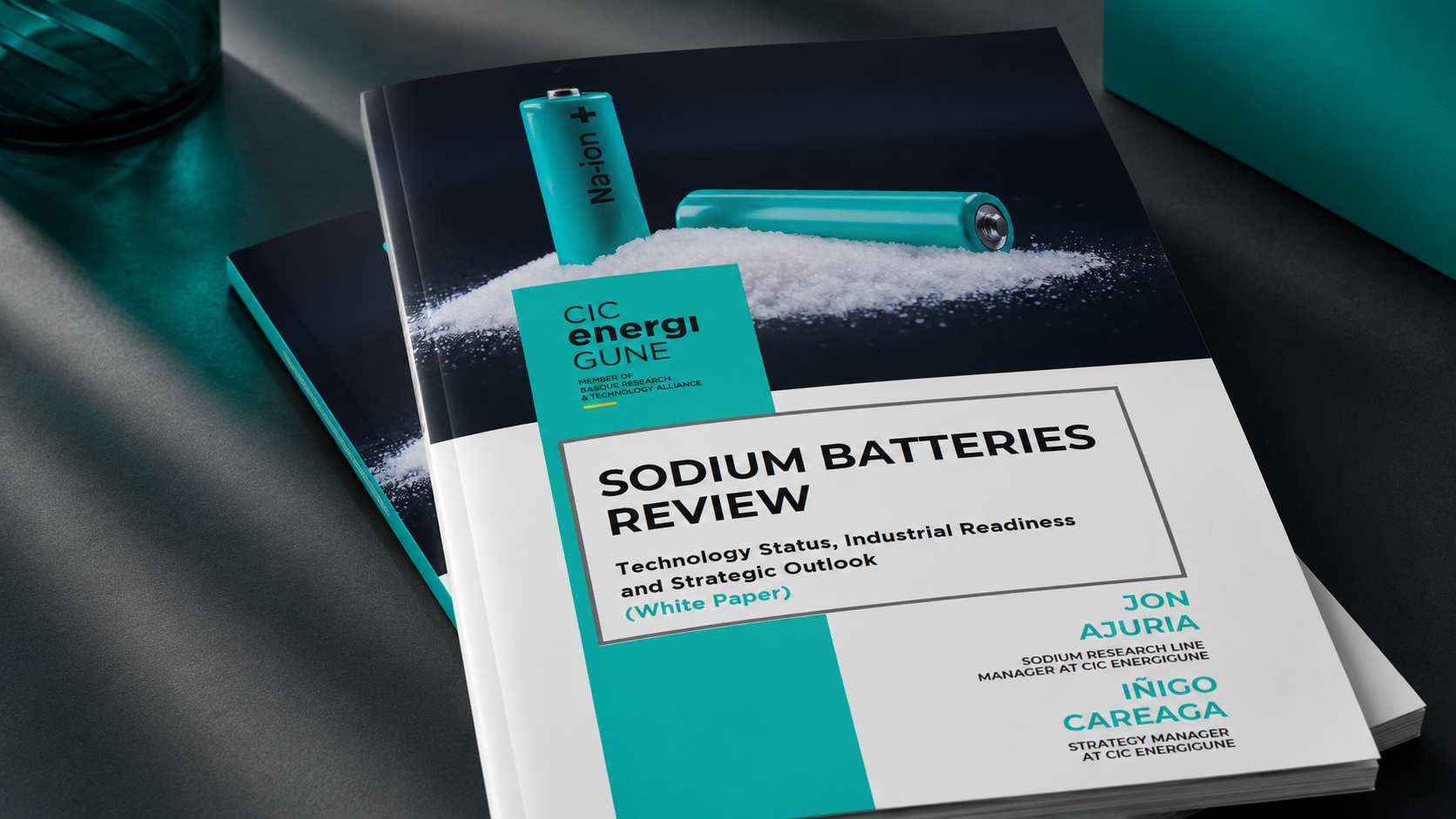
For those wishing to examine the current state of this technology in greater detail, CIC energiGUNE has produced the white paper “Sodium Batteries Review. Technology Status, Industrial Readiness and Strategic Outlook”.
The report provides a comprehensive overview of the technological status of sodium-ion, its value proposition, the main technical and chemical challenges, its level of industrial maturity, market opportunities, cost positioning, sustainability and regulation, and the factors that will shape its progress towards scalable commercial adoption.
It is aimed particularly at battery manufacturers, material suppliers, OEMs, energy storage system developers, investors and other industrial stakeholders who need to understand where sodium-ion technology can create value, the role it could play alongside lithium-ion batteries and the factors that will determine its development over the coming years.
You can purchase Sodium Batteries Review and explore CIC energiGUNE´s other reports on our website.
If you want to know the latest trends in energy storage and new developments in research, subscribe.

If you want to join a top-level team, collaborate with specialists in multiple disciplines or tell us about your concerns, don't think twice...