
18 February 2027 is marked in red on the calendar of Europe’s battery industry. From that date onwards, batteries for electric vehicles and light means of transport, as well as industrial batteries with a capacity above 2 kWh that are placed on the market or put into service in the European Union, will be required to have their corresponding Digital Battery Passport.

The measure is intended to give each battery a digital identity through which information on its composition, performance, sustainability and life cycle can be accessed. Although the visible element for users will be a QR code, behind it there will need to be an infrastructure capable of bringing together and updating data from numerous actors.

That is where the difficulty lies. Implementing the passport is not simply a matter of generating an identifier; it requires manufacturers, suppliers, integrators and operators to work with information that is compatible, reliable and available when needed. Europe has spent years preparing standards and data models, but with only a few months to go before the rules take effect, the question is no longer whether a sufficient regulatory framework exists, but whether industry will be able to translate it into real-world operations.

AN INDUSTRY MOVING AT DIFFERENT SPEEDS

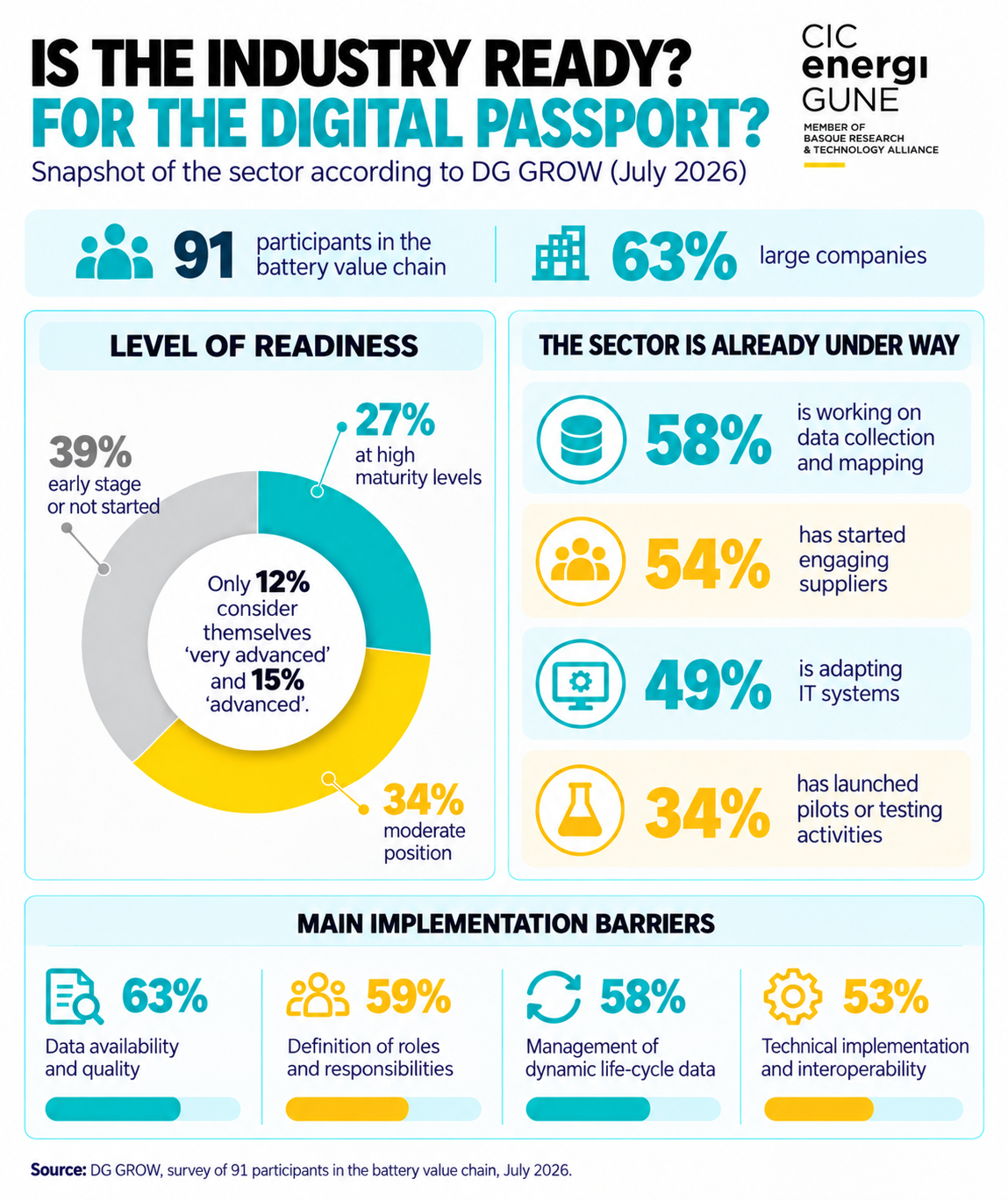
One of the clearest snapshots available comes from the European Commission itself. In July 2026, DG GROW presented the results of a survey of 91 participants across the battery value chain. Large companies predominated, accounting for 63% of the sample.

The results show an industry in motion, although still far from completing the transition. Only 12% of organisations considered their level of readiness to be “very advanced”, while another 15% rated it as “advanced”. Overall, just 27% said they were at the highest levels of maturity, while 34% were at a moderate stage and the remaining 39% were still at an early stage or had not yet started.

This does not mean companies are standing still. Some 58% are already working on data collection and mapping, 54% have begun engaging their suppliers, and 49% are adapting IT systems. However, only 34% had started pilot projects or testing activities.

The difference matters because the real challenge emerges when systems have to communicate with one another. In fact, only 15% identified QR codes and unique identifiers among the technical areas that would require the greatest effort, whereas supplier data integration reached 51%.

The message is clear: the problem is not the QR code, but everything that needs to exist behind it.

The information required by the passport is distributed among raw-material producers, material and cell manufacturers, integrators, vehicle manufacturers and, later on, companies specialising in repair, second life or recycling. No single company necessarily controls all the data it will need to use.

That is why, when the Commission asked about the main implementation barriers, data availability and quality ranked first, cited by 63% of participants. This was followed by defining roles and responsibilities, at 59%; managing dynamic data throughout the life cycle, at 58%; and technical implementation and interoperability, at 53%.

The pressure increases when the calendar is taken into account. Only 35% said they were very or fairly confident that the necessary data would be available within their value chain by February 2027, while 41% had little or no confidence that they would be able to achieve this in time.

The picture, therefore, is not one of an unprepared industry, but nor is it a sector that has completed all its homework. Many companies have started the process, although moving from regulatory analysis to the real integration of information remains one of the major tasks still to be completed.

EUROPE HAS THE INFRASTRUCTURE; NOW IT NEEDS THE DATA

If the analysis shifts from individual companies to the common infrastructure, the situation looks more favourable. During 2026, Europe has taken several steps suggesting that a large share of the technical elements required will be available by February 2027.

One of the most significant advances came on 20 July, when the European Digital Product Passport registry became operational. This central component of the ecosystem makes it possible to register identifiers, operator information and certain metadata needed to locate and verify passports.

At the same time, CEN and CENELEC have been working on eight harmonised standards covering unique identifiers, data carriers, application programming interfaces, exchange protocols, interoperability and storage. Six had already been adopted by July 2026, while the Commission’s roadmap scheduled a decision on the remaining two for September.

This may look like technical work, but it is essential: if each company describes the same attributes differently or uses incompatible identifiers, the passport risks becoming a collection of isolated solutions.

The Commission has also made progress on another critical point: defining more precisely what information companies will need to manage. In August 2026, it published an updated guide bringing together 71 data points and indicating their legal basis and applicability to the different battery categories.

The guide reduces uncertainty, although identifying a data point as mandatory does not mean it already exists within the company, especially when it comes from actors several tiers upstream in the supply chain. In addition, while some attributes will remain stable, others will change with use, meaning that the passport will need to function as a living information infrastructure.

In this context, BatteryPass-Ready launched an environment in June 2026 where manufacturers and suppliers can validate their data and test the interoperability of their solutions. The platform started with eleven test scenarios and was developed on the basis of contributions from more than one hundred partners and collaborating organisations.

These initiatives make it possible to check whether data are complete, transmitted in the appropriate format and interpretable by different systems. Europe appears to be rapidly building the roads along which information will have to travel. The challenge is ensuring that companies have the fuel they need: complete, reliable and traceable data.

MUCH MORE THAN A NEW QR CODE

Regulatory pressure explains much of the current effort, but reducing the Digital Battery Passport to a new compliance obligation would mean focusing only on its most immediate effect.

If industry succeeds in creating an infrastructure in which information accompanies batteries through a significant part of their useful life, the possibilities go far beyond demonstrating that a product complies with a standard. The same data that must now be collected for regulatory reasons could be used to improve decisions related to maintenance, repair, reuse, second life or recycling.

Consider a battery reaching the end of its first use. Deciding what to do with it may require knowledge of its composition, its initial characteristics and certain data on its use or condition. If that information has been lost, it will have to be reconstructed through testing or additional characterisation processes; if it remains linked to a digital identity, decisions can be made faster and on a better-informed basis.

The passport can also help reduce one of the major barriers to the circular economy: the loss of information when a product changes owner, application or stage in its life cycle. The manufacturer holds data that may never reach the repairer; the second-life operator needs information stored in another system; and the recycler may receive a product about which far less is known than would be desirable.

For that promise to become a reality, it will be necessary to define who can access each data point, how confidential information is protected and who is responsible for updating information that changes over time. This is why the challenge is as organisational as it is technological: buying a software solution and linking it to a QR code will not be enough. Companies will need to review processes, identify responsible parties, engage suppliers and establish data-quality mechanisms.

Europe appears to be relatively well prepared in terms of the common framework: the registry is operational, the standards are progressing, and companies have environments in which to test their solutions. The situation is less consistent when it comes to their actual ability to collect and share data. The coming months will be decisive for connecting systems and verifying that information can move through the value chain without losing quality or meaning.

February 2027 should not be seen only as a deadline, but as the beginning of a period in which data management will play an increasingly important role in the battery industry. As the passport becomes established, areas such as advanced characterisation, sustainability, life-cycle assessment, second life, recycling and digitalisation will become increasingly important, because they will help not only to meet new requirements but also to turn that information into higher-value industrial decisions.

Europe appears to have covered a large part of the ground needed for the Digital Battery Passport to become a reality. What remains is probably the most difficult part: ensuring that the entire value chain is capable of using it.

Because, once the system becomes mandatory, the real challenge will not be generating a digital passport, but ensuring that reliable, interoperable and traceable information exists behind it, making it possible to understand each battery better and make better decisions throughout its entire life cycle.

Cookies on this website are used to personalize content and advertisements, provide social media features, and analyze traffic. You can get more information and configure your preferences HERE