
But between identifying that need and having a solution robust enough to move towards industrialisation, there is a long road.
What determines whether a material delivers good performance reproducibly and can maintain it when scaled up and subsequently integrated into an electrode or device?
This is a common question in advanced materials development, with a direct consequence for any R&D project: time, resources and budget devoted to reducing uncertainty.
The cost of discovering too late that a material does not work
One of the main challenges in materials development is not only to identify candidates, but also to understand which factors will actually determine their performance and limitations in the real application.
The combination of compositions, raw materials and synthesis conditions can generate a very broad experimental space. Exploring all these possibilities through conventional experimental campaigns requires time and resources; moreover, some critical parameters can sometimes go unnoticed at laboratory scale and become limiting factors during the advanced stages of industrialisation.
A candidate may initially deliver good performance and later present stability, reproducibility or processability problems. However, detecting a limitation does not necessarily mean that the material should be discarded: understanding its origin can make it possible to develop improvement strategies, optimise the composition or adjust the synthesis process.
The later a limitation is detected, the higher the associated cost tends to be. That is why accelerating materials development is not simply about carrying out more experiments in less time. Therefore, accelerating materials development is not simply about carrying out more experiments in less time, but about obtaining the knowledge needed earlier to understand the critical factors, design corrective solutions and efficiently guide the next stages of development.
From trial and error to more targeted development
Scientific knowledge and researchers’ experience remain fundamental, but they can now be complemented by new tools capable of making the development process much more efficient.
Computational screening can help prioritise candidates before moving into the laboratory. Subsequently, high-throughput experimentation methodologies make it possible to systematically study multiple compositions and synthesis conditions, generating comparable data to identify the alternatives with the greatest potential more quickly.
Automation also introduces another important element: reproducibility. Working under more controlled protocols makes it easier to compare results and understand which variables are actually influencing the material’s behaviour.
As more data are generated, advanced analysis and artificial intelligence tools can also help identify relationships between composition, process and performance, helping to guide subsequent experimental campaigns.
At CIC energiGUNE, we are developing this approach through MAITENA —Materials Acceleration and Innovation plaTform for ENergy Applications—, a platform that combines automated synthesis, high-throughput experimentation, characterisation, data management, modelling and artificial intelligence.
The aim is not to replace researchers’ expertise, but to use it more efficiently: explore better, discard earlier and focus resources on the candidates with the greatest chances of success.
Finding a good composition is not enough
Finding a material that delivers good performance is only one part of the development process. It is also necessary to verify that this performance can be achieved reproducibly and to understand which variables determine its behaviour.
Composition and the synthesis process are closely related. Changes in raw materials, treatment conditions, material microstructure, the presence of impurities or the use of certain process parameters can significantly alter the final result.
For this reason, in addition to identifying new materials, it is important to develop robust synthesis routes and establish clear relationships between how a material is produced and the properties it ultimately exhibits.
This can be particularly relevant for a company that already has a promising candidate but needs to improve its reproducibility, optimise its process, assess the impact of the material’s microstructure and the presence of impurities, and/or seek alternative raw materials.
Likewise, understanding why a material loses performance or degrades makes it possible to take decisions before moving on to more costly stages. Advanced characterisation, including characterisation performed while the material is operating, helps identify these mechanisms and guide subsequent optimisation.
The objective is once again the same: reduce uncertainty before scaling up.
From material to industrial process
There is one final, particularly important barrier. A material may work perfectly at laboratory scale and encounter difficulties when larger quantities are produced or when it is integrated into an application.
For this reason, its development should not end when a composition with good performance is identified.
It is also necessary to ask whether it can be produced reproducibly, whether the raw materials and process are suitable, whether it retains its properties as scale increases, and whether it can be correctly integrated into the subsequent manufacturing steps.
In the case of battery materials, for example, this means moving from powder to electrode processing and subsequently to cell validation. This continuity is particularly relevant from an industrial perspective because it makes it possible to introduce criteria relating to processability, integration and scalability.
On the other hand, in battery materials, certain parameters that may initially be considered secondary, such as the presence of low-concentration impurities or variations in microstructure and the presence of crystal defects, can have a decisive impact on the stability and cycle life of cells in real applications. Therefore, understanding the relationships between composition, process, structure and performance throughout the different scale-up stages towards industrial production is essential to define appropriate material specifications and ensure a reproducible transition from the laboratory to production.
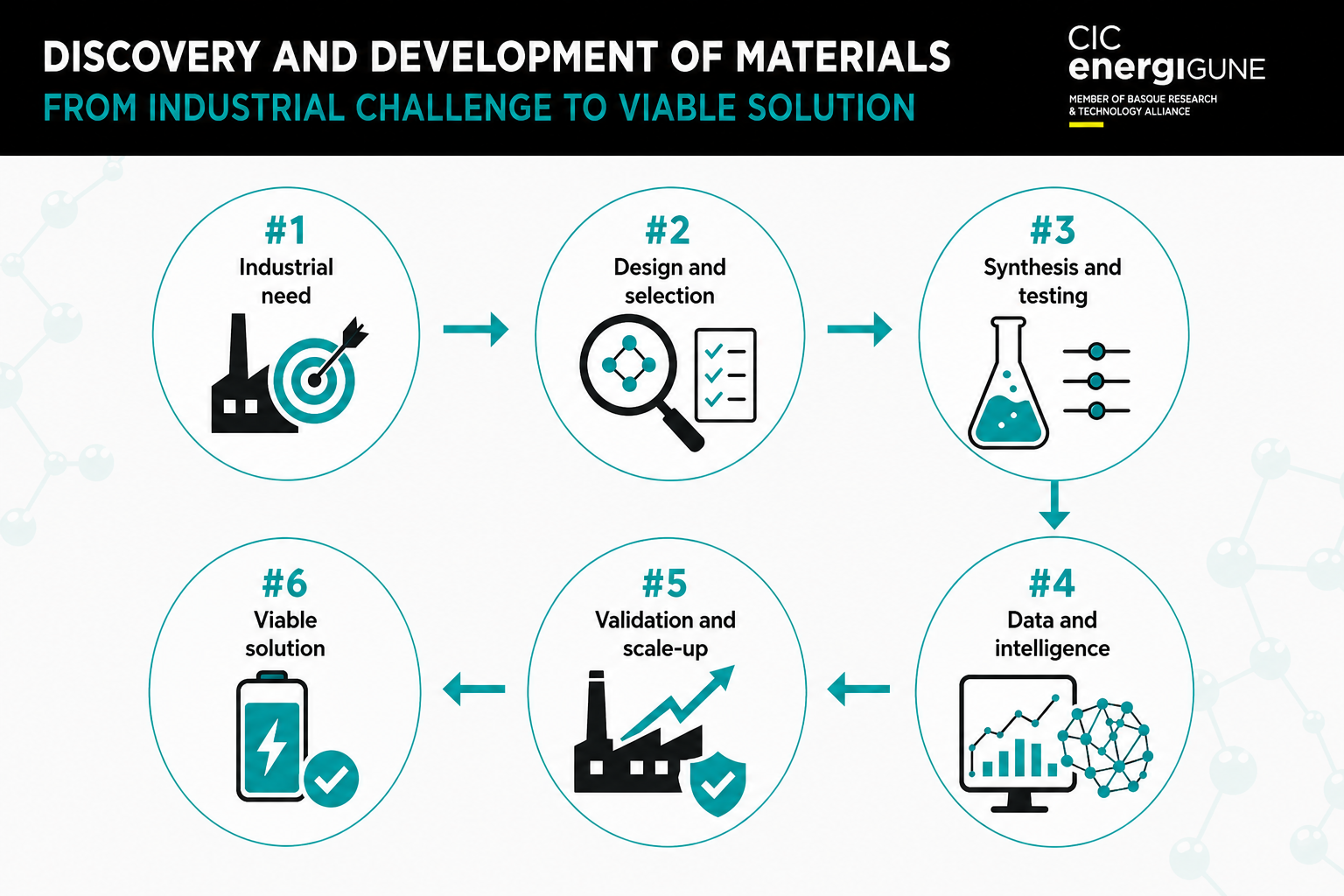
At CIC energiGUNE, our materials development capabilities range from initial design and screening to synthesis, characterisation, understanding operating mechanisms, optimisation and scale-up, with the possibility of subsequently continuing towards electrode manufacturing, prototyping and cell validation.
In this way, a candidate can be assessed not only on the basis of its laboratory-scale results, but also on its potential to continue progressing towards a real application.